Showing posts with label Politics. Show all posts

Sunday, March 25, 2018

Facebook and Cambridge Analytical Screwed Up, But Not How You Think

Facebook: Open for Advertising, Open for Business
There’s a huge kerfuffle over the recent revelation that Cambridge Analytica, a political research and advertising firm, used data from millions of Facebook accounts in order to build behavioral profiles and then, using those profiling models, advertise to people and manipulate their voting behavior.

People are upset over this, but, it’s not for the reasons that most people are talking about, that is, it isn’t that either Facebook or Cambridge Analytica behaved unethically. They didn’t. They behaved exactly as they were supposed to. The mistake they made was that Facebook users were reminded of how it all works.

What do I mean?

Let’s back up a minute, and look at both Facebook’s business model and also how advertising works.

Facebook is a social networking site, where you can connect with lots of people. That’s not a business model—there is no mention of how the rent is paid (salaries, their giant electrical bill, money to buy new servers and replace old ones). The business model is actually a very old one, one that’s been around for decades: advertising. As any old-school American television scholar will tell you, “If the product is free, you are the product.” This has been true for broadcast television and radio for decades. But as television offerings and the idea of “radio” have complexified, the idea “over-the-air” broadcasting has been somewhat forgotten: many people get their local, i.e., broadcast, television via cable, satellite, or the internet. The local airwave component is not part of that picture even though it’s still there.

The advertising industry, for decades, has wanted perfect consumer profiles for each and every individual. This way they can advertise to you perfectly. “Advertise” is just a polite word for manipulate. Yes, manipulate. Not influence, not coerce, but manipulate. It’s behavioral propaganda. Credit card data and frequent shopper cards were a good start, but the internet, once it reached the right scale, was a bonanza of behavioral data. With big data capabilities, perfect advertising may finally be within reach.

Most advertising that we think about is consumer-based, trying to get you to buy a product. Yes, you, buy this. That’s the idea. It is that basic. And political advertising is exactly the same: behavioral acceptance of a product. But in this case, your behavior is voting, not buying, and the product is a politician, not a good or service (that could be argued but doesn’t matter). It’s the same: advertisements try to manipulate your behavior to the advertiser’s desired outcome.

There is one other important aspect to advertising: that you not think about the advertising. And that’s where the failure is for Facebook and Cambridge Analytica. When you think about the advertising and how it really works, you realize you are the product. If you realize your vote, which is supposed to be sacrosanct, can be manipulated, then it throws into question what you might want to think about democracy and free will. (If you do not live in a democracy, this explanation probably seems short-sighted.) Capitalism is triumphing over democracy, and it’s not supposed to be that way.

Except, it is. Facebook thrives on a user-based advertising model where you are the product. All of your data and access to you is sold to advertisers, or, if Facebook can keep your data, Facebook itself can make all the behavioral models and then sell access to you (the advertisers will still need to make the “right” advertisements, but Facebook will provide the “right” people). Advertising works by showing you what will manipulate you into the desired behavior, be it buying or voting—they’re the same, it’s just a selection on your part.

Facebook will continue to make its service available for free to users, and can do so because the users are the product. Again, this is not new. Facebook sells access to its users to advertisers with precision targeting because Facebook has so much data about your behaviors and preferences, and although there are other financial models this is the one Facebook is currently using. Advertisers try to manipulate your preferences and behaviors based on your past preferences and behaviors.

None of this is new. (Suddenly, my media studies degree is looking pretty hot!)

Where they screwed up was that users remembered that they, the users, were the product, and that they, the users, were the subject of manipulation in the political domain where an individual’s voting preference is supposed to be pristine, determined solely by the voter, beyond manipulation and not for sale. Except, that isn’t true. Just most of the time we don’t want to think about it.

Addendum 1: Google's business model is also advertising.
Addendum 2: Zuckerberg's first website.

Sunday, November 15, 2015

Facebook, Paris, Beruit

A lot has been written about how Facebook activated its "Safety Check" feature for the recent Paris terrorist attack, but not for one the previous day in Beirut. There is some good commentary, from less well known sites to the bigger news sites to personal blogs.

So what are we left with?

Facebook is a part of the global media fabric as much as any other site, they not only act as gatekeepers for news but act within the news environment and ideas about what constitutes news. Facebook is based in California, and so most of the employees who make up the organization we call Facebook are American: they grew up within a specific media environment which had clear but subtle ideas about what news is. (As an aside, I wonder how many employees at Facebook who are involved in the curation of people's feed have any background in actual journalism.) To understand this framing of what is news and what isn't, we need to understand global history and the flow of information, a flow which often parallels economic flows. So yes, we need to understand words that some framings have determined should make us uneasy, such as imperialism and colonialism. (Think about it this way: in the Babar series of children's books, when Africans wear European clothes they are portrayed as good, but when there are Africans who wear non-European, "traditional", or "pre-contact" clothes [I am not sure what the best term is], they are portrayed as backwards -- yes, they are elephants and rhinoceroses, but they are being used as humans in the stories. This has not gone unnoticed.) Because often parts of the world that were used for colonialism and imperialism, empire building, and the extraction of goods through forced labor and violence, are now the parts that are not worthy of news coverage, although it isn't quite so easy and straightforward.

But what we do have is highly problematic, besides the sadly common lack of coverage in some parts of the world -- the Western news media didn't cover the Beirut attacks very much, neither did Facebook, and both of these non-reactions are for exactly the same reasons which can be couched in economic terms but have deeper cultural and historical roots. Facebook doesn't have as many users, most likely, who are directly connected to Beirut, but it has many more with connections to France. The same is true for their employees. But they are also reacting to what they see in the media and perhaps to trends they are continually monitoring, live, in the overall Facebook environment.

Like the media, Facebook is essentially bestowing the idea of newsworthiness on some issues and also deciding that some other things are not newsworthy at all. That really is a big problem, as it's clear no one there is qualified to do so. This is also a well-known issue more broadly and is not at all new. This is not to say it's good, it's not at all good, nor is it to say Facebook shouldn't have activated the "Safety Check" feature. I appreciated it, as I have friends in Paris.

There are also some technical issues, beyond deciding which events qualify.

For example, for an earthquake, what if I check in as "safe" after the initial earthquake, and then am killed shortly thereafter by an aftershock? (The same issue holds for other kinds of events, such as terrorist attacks.)

Facebook's page about the Safety Check says it's for natural disasters (as of November 15th, 2015), and does not mention other events such as terrorist attacks, nor how any of these will be selected. Yet it was used for an event that was not a natural disaster.

More broadly, it could be argued that being black, female, or GLBT,  in America is to live under constant threat (there are many other examples but I am not qualified to discuss them much, nor can I make an exhaustive list, this is just an example). But, like the framework that silently suggests that Beirut is less coverage worthy than Paris, these issues should be kept quiet.

Facebook has taken action in a very contentious area, one where ideology and hegemony are heavily invested in outcomes and how we think about what is worth thinking about. Yes, as we should expect from most gigantic global companies, they did a bad job. As we know, people have been discussing these issues for a long time. These issues are still issues. Now, more people are talking. That's an important step. Steps are how we move forward.

Addendum: There is also the profile picture change to overlay the French flag on your profile photo, which again is not a bad idea, the problem is still which events are worthy of this level of attention, who is deciding, and how are these decisions made. It's the same problem as that with big data algorithms, except here it's with people's decision making.


Addendum, part 2: Here is an article from The Verge about why the people at Facebook who make these decisions did so, but I personally don't find the official explanation very satisfying about the criteria for their selection of events because the official response avoids all of the difficult issues that most people are talking about. If you're a company like Facebook, you can address these issues in a much better, direct, and clear manner. 

Friday, October 30, 2015

The Civic Data Divide

I'd like to coin the term "civic data divide", and given that Google shows zero results for it, I think I can make that claim.

More importantly, I've been working on a paper looking at factors that affect the strength of a nation's open data policy. The numbers show that, although some people have theorized about the importance of both internet access and education for open civic data, neither of these factors play a role, at least not on the national level, indicating that, as we might expect, the early users of and agitators for open civic data are those who can use it: those who have internet access and those with the education to work with numbers. This is a minority of the citizenry, and as such the national measures for overall education and overall internet connectivity do not statistically relate to the strength of a nation's open data policy.

This should not come as a surprise, given the many other socio-economic divides in terms of access we've seen before, such as the digital divide. The civic data divide, I would argue, is an extension of what scholar Pippa Norris has discussed as the democratic divide, where there are some who use the internet to engage with governance and those who do not or cannot.

Yet this is not an overly problematic scenario. Internet access and education are indeed not evenly distributed across any one country, but many of those working with civic data and open data policies work every day with the issues faced by nations and cities, and as such they are aware of and engaged with socio-economic inequalities, and, more importantly, are trying to address the issues and make things better for all citizens. Along with the expansion of civic data programs and outreach (such as MIT's Civic Data Design Lab and NYU's Center for Urban Science and Progress), although the civic data divide currently exists, the very ideals behind open civic data are working to overcome it.

Google as of October 30, 2015, 5pm NYC time.

Edit: So, this does imply that those working on civic data are able to utilize their resources (socio-economic) for education so they have data skills, and so they can do this outside of their nation's educational system. But besides those that already have the resources for education, I'm guessing there are some who instead learn the needed skills via online courses, meetups, and other alternative educational avenues. But you still have to have the time to work on these projects.

Friday, November 14, 2014

All the Data? Yes.

Been quiet here since I took a three-month post over at Democracy Works for the Voting Information Project (you know, twelve hour days, weekends, all that, which still means a lot easier hours-wise than being a professor). It's an ongoing, yet outwardly an election-year, project with Google and the Pew Charitable Trust to help get voters information about when and where to vote as well as ballot information (ok technically that's the Ballot Information Project, but it's all bundled together into one end product).

So we had to get.... ALL THE DATA... for every polling location in the 50 US states and DC. Some states partner with the project, but for the ones that don't we had to make lots of web visits to county websites and phone calls to county clerks. LOTS.

It was awesome. But, it took all my time. And, you can't even see it anymore! If you Googled something to the effect of "where do I vote" you'd get an infobox, and could enter your address, geocoding magic would happen, and you could get a map to your polling location!

Awesome.


Friday, November 9, 2012

Election Numbers and Massachusetts

(I could reframe this in the following manner: The most telling vote of the election... was it how women voted? How minorities voted? Latinos and Hispanics? Regions? White people? Evangelicals? No. The most telling vote was instead from one small state in the corner of America: Massachusetts.)

Perhaps the most telling numbers from the election come from Massachusetts--the only state to have direct experience with both President Obama and Mitt Romney as chief executives. Massachusetts voters had four years of Mitt Romney as governor, and also had four years of President Obama as US President. Given this unparalleled experience, how did they vote?

The results are clear.

Massachusetts

Obama1,900,57560.8%
Romney1,177,37037.6%

That's a one-sided endorsement. (Percentages do not add to 100% because I didn't include the "Other" votes which are part of the total.)

Sunday, January 15, 2012

SOPA, PIPA, Benkler

SOPA and PIPA have made a lot of headlines lately, deservedly so, Luckily the White House stepped up and said Obama wouldn't sign either of these horribly misguided bills. (Edit: Or, apparently only SOPA is shelved?)

I'd like to quote Benkler, from his Wealth of Networks (2006), p. 2:

The rise of greater scope for individual and cooperative nonmarket pro- duction of information and culture, however, threatens the incumbents of the industrial information economy. At the beginning of the twenty-first century, we find ourselves in the midst of a battle over the institutional ecology of the digital environment. A wide range of laws and institutions— from broad areas like telecommunications, copyright, or international trade regulation, to minutiae like the rules for registering domain names or whether digital television receivers will be required by law to recognize a particular code—are being tugged and warped in efforts to tilt the playing field toward one way of doing things or the other. How these battles turn out over the next decade or so will likely have a significant effect on how we come to know what is going on in the world we occupy, and to what extent and in what forms we will be able—as autonomous individuals, as citizens, and as participants in cultures and communities—to affect how we and others see the world as it is and as it might be.
Spot-on. There are two other angles to the story, one, companies following the old business models that have always worked in the past and doing so until the company is run into the ground, and two, those with wealth and power both ignoring the law and bending the law to their will, making laws that benefit them.

Edit: MIT Media Lab Director Joi Ito's take on the bills.

Wednesday, April 21, 2010

Idiots on Parade and Net Neutrality

John W. Mayo and Marius Schwartz are professors of economics at Georgetown. Bruce Owen is a professor of public policy at Stanford. Robert Shapiro is a senior policy fellow at the Georgetown Center for Business and Public Policy. Lawrence J. White is a professor of economics at New York University’s Stern School of Business. Glenn Woroch is the executive director of the Center for Research on Telecommunications Policy at the University of California, Berkeley.

They are also all complete idiots.

They have an opinion piece in the New York Times today. In it, they claim that net neutrality...

could stifle the innovation that has been the hallmark of the Internet.

Idiots. Net neutrality is what built the Internet, and what has made it so innovative.
You will notice that they are all economics and policy people, with one telecom person. There are no Internet people. There are no Internet innovators. No lawyers. Only those who were brought up in an environment where they were told by others, "Control is the one true way." They know nothing about the Internet.

Thursday, January 28, 2010

Dear China...

There was some language recently about the Google attacks where a Chinese representative said how American criticism was hurting American-Chinese relations.


Dear China (meaning, the Chinese government), your criticism of our criticism hurts our relations. And here we thought you had capable Internet hackers! Turns out, you don't, according to what you say.

Wednesday, June 17, 2009

Iran and Media

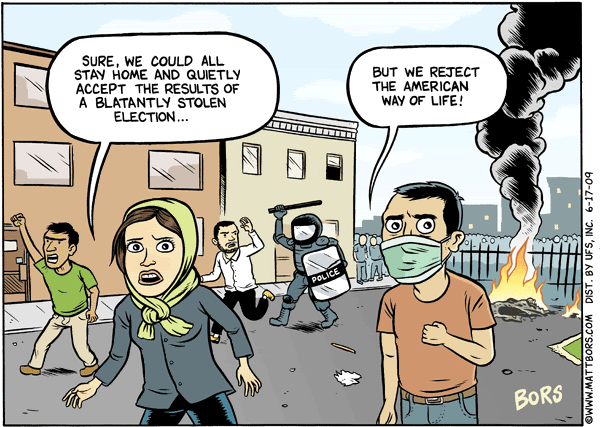
Lots of interesting coverage of Iran. Two things have jumped out at me. One, signs in English (I don't know how widely English is used, or if it is at all, Iranians typically speak Persian), and two, how uses of media technology to distribute information under difficult political circumstances hasn't changed all that much (only the specific technology has).


From an article in Slate by Harry Newman:
During the time of the anti-shah protests, Ayatollah Ruhollah Khomeini was exiled near Paris. His speeches were transmitted by telephone into Iran, recorded onto cassette, and then thousands of dubbed copies were distributed to his followers. Today, opposition figures in Iran and abroad are using social-networking technology to publicize their protests. Both then and now, international media—above all, diaspora Persian-language news broadcasts—play a critical role in expanding the opposition forces.
Technology changes, people don't.

Picture with Persian and English signs, credit: BEHROUZ MEHRI/AFP/Getty Images, from Boston.com.

Update: Aha! Jason Rezaian writes at Slate, "Many carried signs in English, intended for the noticeably absent foreign media to snap." He is not just writing in a safe little room like I am, here is there (well, if you believe what you read at Slate, and there are plenty of journalists there and a ton of info is really getting out via various channels, so I don't see why not).

Update 2: Finally someone is comparing the theft of the election in Iran with the theft of the 2000 election in the US (Austin Heap at Salon).


Update 4: Aha!

Wednesday, June 3, 2009

Manipulating the Masses

Errol Morris is at it again, with another riveting series of long blog posts over at the NYT, this time about a WWII-era forger for the Nazis, Van Meegeren. Except I don't want to post about that, not exactly. I want to copy a snippet from a Göring quote, Göring the thoroughly evil man that he was, who is part of the story (since Van Meegeren was passing his forgeries off as Vermeers to the Nazis).

The people can always be brought to the bidding of the leaders. That is easy. All you have to do is tell them they are being attacked and denounce the pacifists for lack of patriotism and exposing the country to danger. It works the same way in any country.
That strategy sounds... familiar...

Thursday, March 19, 2009

DMCA Fail

From "Google submission hammers section 92A", by Ted Gibbons, for New Zealand PCWorld:

Google notes that more than half (57%) of the takedown notices it has received under the US Digital Millennium Copyright Act 1998, were sent by business targeting competitors and over one third (37%) of notices were not valid copyright claims.
You see what's wrong with that, right? The 57% doesn't bother me so much, but only if the claims are valid. The 37% is horrible. I could go on to explain why, but I'll let the EFF explain the DMCA.

Tuesday, February 3, 2009

Collapse of the (Information?) Economy

The economy is toast. Which economy? If we really were in an information economy, I'd say we just saw the fragility of it. But, although information (all the wrong information) did indeed play a part of the economy's collapse, I'd argue that it was not the information economy, but an economy of far more tangible objects (perhaps houses and oil and more, I'm not sure, if it were easy, we would have avoided it I think). So I'd argue we weren't really in an information economy, although information is an important part of the economy. Either, information was the primary part of the economy and it collapsed, so an information economy is a stupid thing, or, it wasn't the information part of the economy that collapsed and thus I would argue we weren't really in an information economy.

As I argued many years ago, oil is king. Still is. Not that we are in an oil economy, but, maybe we are. Info? No.

Friday, January 23, 2009

44

It is really nice to have a legit President (one who was actually elected) and one that can speak English really, really well.

Transcript of Obama's inauguration speech.

Analysis by Stanley Fish.

Wednesday, January 21, 2009

Diversity is Strength

Technologically, biologically, culturally. Think diversity of opinion.

The president’s elderly stepgrandmother brought him an oxtail fly whisk, a mark of power at home in Kenya. Cousins journeyed from the South Carolina town where the first lady’s great-great-grandfather was born into slavery, while the rabbi in the family came from the synagogue where he had been commemorating Martin Luther King’s Birthday. The president and first lady’s siblings were there, too, of course: his Indonesian-American half-sister, who brought her Chinese-Canadian husband, and her brother, a black man with a white wife.

(From the NYT, by Jodi Kantor.)

Friday, November 21, 2008

Voting Interfaces

Here in my precinct we used the massive, ancient lever machines yet again (the main lever, which is pretty hefty, makes a very satisfying sound), but across the US we have all sorts of different ways to vote (or, mis-vote). 


Minnesota Public Radio has put online some photos of some disputed ballots in their current recount. You'd think filling out an oval would be easy, but, no.

Thursday, November 20, 2008

A Series of Tubes


I have found the Internet! (A.k.a., "teh internets" but I hope you are all in on the in-group nomenclature by now.) It is, you recall, a series of tubes, another bit of insider lingo brought to us by convicted felon and former Senator Ted Stevens.

And yes I actually took that photo, it is not from teh googles.

Saturday, July 12, 2008

Airport! Danger!

For the last three summers, IIRC, this sign has been up at ACK, the Nantucket airport. Maybe it is not up in the off-season. ACK is a very small airport, in the middle of nowhere on the island, and, if you didn't notice, it's on a small island. Let me be clear: small. Not a lot of people. Yes it gets relatively busy, I am aware of that: relatively. There are really never many people there compared to large regional airports that do not serve seasonal destinations. In other words, it is not a sensible terrorist target (the it's on an island part helps, but don't cite the Bali bombings because I've been to Bali and it is much larger, and very different in several other relevant ways).

High risk? Really? No. And what is "red", is that "we know one is about to happen"? (Let us change the posted placards first!)
Ok, DHS says it is "orange or high" for all airports. (Well which is it, orange or high? Please choose one.) Elevated, High, Severe. This sound like the US Postal Service's naming for mail, "Priority" and "First Class". Honestly if you're going to use a labeling scheme, use labels that are easily differentiated from one another.

Wednesday, July 9, 2008

The 4th Amendment is Dead

Long live the 4th Amendment.


Sometimes I do not cover things because those stories are covered at great length in many other spots, several of which are linked to from here. However, sometimes things are too important to not mention. Today, the US Senate, mainly republicans (who were in charge when 9/11 happened, thank you), voted to gut the US Constitution. As others have pointed out, Bush said Bin Laden (still out there) hated our freedoms (even though that's not what Bin Laden talks about), so Bush is taking away our freedoms in order to make use safer (nice plan!).

The 4th Amendment is the latest victim, along with all of us.